
The Kamiyubetsu Tulip Park (かみゆうべつチューリップ公園, Kamiyūbetsu Chūrippu Kōen) is the larger of Hokkaido’s two big spring flower parks and one of the better tulip displays in Japan. Seven hectares of cultivated bed, 700,000 individual tulip plants, 200 named varieties — including genuinely rare Dutch cultivars imported specifically for this site — laid out in coloured bands across a gentle east-facing slope in the town of Yubetsu, north-central Hokkaido. The annual festival runs through May. If you’ve already planned around the Takinoue moss pink field and want to combine tulips on the same trip — and the same season works for both — Kamiyubetsu is 30 minutes away by car.
In This Article
- Quick facts
- What the park actually is
- The varieties and what to look for
- The Tulip no Yu onsen (combine with the park)
- Getting there and logistics
- Combining with other eastern Hokkaido spring sights
- Where to stay
- Is the park worth the trip?
- FAQ
- When is peak bloom?
- Is the park accessible year-round?
- Can I actually buy and take tulips home?
- Is the park genuinely Dutch-themed?
- How does the park compare to Huis Ten Bosch?
- Is there food in the park?
- Is it a good stop for non-flower-enthusiasts?
The park has a specific historical pedigree that sets it apart from Japanese tulip displays you may have seen at bigger tourism hubs. Yubetsu’s tulip cultivation started in the early 1950s as part of a post-war agricultural diversification project — the local JA agricultural cooperative imported bulbs from the Netherlands and trained farmers as a complement to the then-dominant potato and sugar-beet industries. The first public festival was held in 1957; the current park site was established in 1989 after the town decided to expand the display into a full tourism asset. Today it’s run by the Yubetsu municipal tourism board and attracts about 100,000 visitors per May festival.
Quick facts
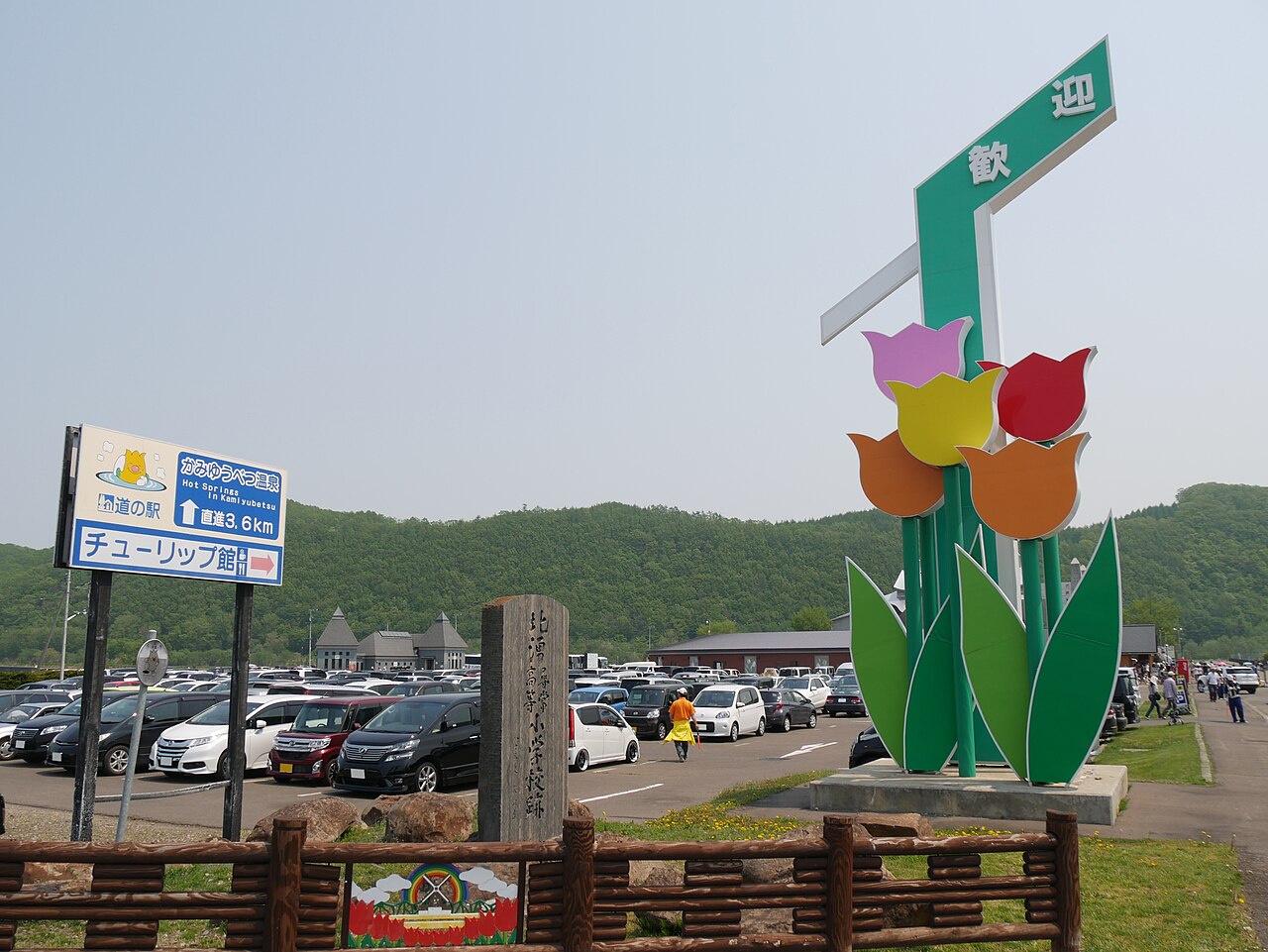
- Where: Kamiyubetsu Tulip Park, 358-1 Kamiyubetsu Tonden Shigaichi, Yubetsu-cho, Monbetsu-gun, Hokkaido 099-6404. Northeast Hokkaido, inland from the Okhotsk coast.
- Getting there: By car: 30 min from Okhotsk-Monbetsu Airport, 45 min from Asahikawa. By bus: Kitami Bus from JR Engaru Station (20 min, ¥400). From Sapporo: 4-5 hours by car.
- Hours: Festival period only (May 1 – early June), 8:00-18:00 daily (last admission 17:30). Closed outside festival window — the park is not a year-round attraction.
- Cost: ¥600 adult / ¥300 elementary and junior high / free under 6. Parking free (400 spaces).
- When to go: Peak bloom is typically May 15-25. Earlier visits in the first week of May catch the early Dutch varieties; later visits catch the late-blooming local cultivars. Avoid days 1-2 of the festival (opening weekend crowds) and the final weekend (visitors scramble to catch the last blooms).
- Official: Yubetsu town tourism, Hokkaido Tourism Organization (English).
What the park actually is
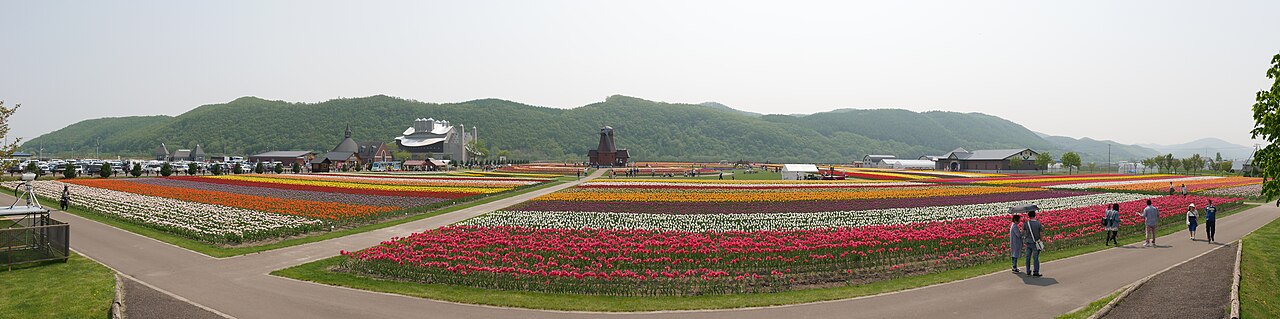
The park is laid out across a 12.5-hectare footprint on the eastern edge of the Yubetsu town centre, with 7 of those hectares planted with tulips and the rest given over to the visitor centre, car park, a small children’s playground, and the “Dutch-themed” display area (windmill, canal, a few stylised northern-European buildings). The tulip beds themselves are laid out in geometric ribbons of colour — red, yellow, pink, white, purple, orange — that snake across the east-facing slope.
The park’s specific design features:
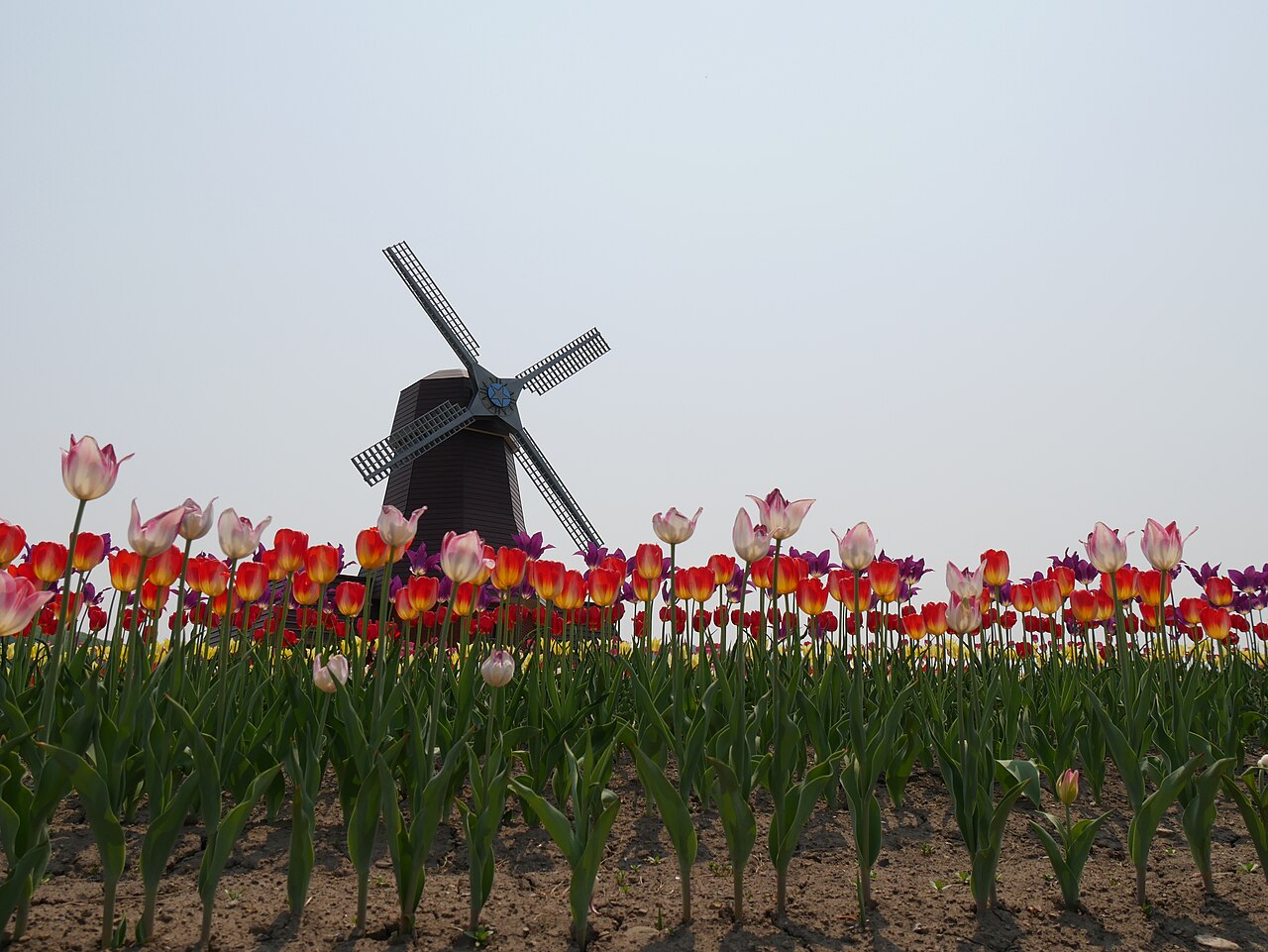
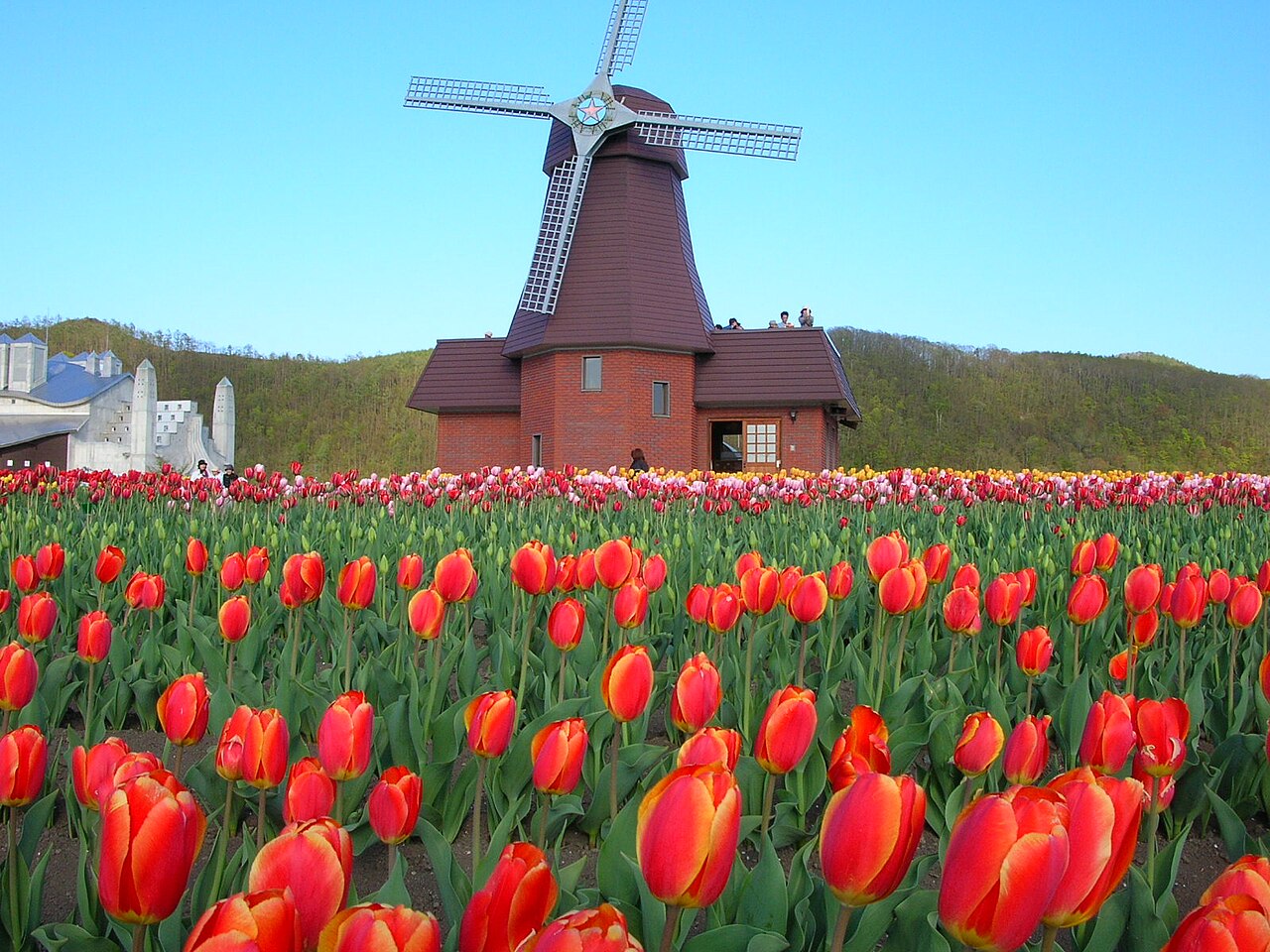
The windmill observation deck (風車型展望台, fūsha-gata tenbōdai) — a Dutch-windmill-style five-storey structure at the top of the slope. Climb it for the aerial view of the full flower field; the colour bands only resolve properly from altitude. Free with park entry.
The electric cart tour (花電車, hana densha, “flower car”) — a small open-sided electric tram that loops through the main flower beds. 18 minutes, ¥500 per person, runs every 20 minutes during the festival. Good for older visitors or anyone who wants to do the park without the walk.
The dig-your-own-tulip area — a specific late-festival feature (typically the final week, usually early June). Visitors can purchase individual tulip bulbs with the plant still flowering, dig them out with a provided trowel, and take them home. ¥100-300 per plant depending on variety. The specific appeal: you’re buying live, freshly-dug Dutch cultivars that you can replant in your own garden, and the selection is more interesting than any Japanese garden-centre inventory.
Children’s programming — the park has a small playground, a pony-ride area (weekends only, ¥500 per ride), and a stamp-rally (“stamp collecting”) activity for kids that runs across the festival period with prizes at the exit.
The varieties and what to look for
Kamiyubetsu’s 200 tulip cultivars span roughly five category groups:
- Single early (Apeldoorn, Princess Victoria) — the classic goblet-shape red-and-yellow tulips. First to bloom; the park’s opening-week feature.
- Triumph (Kees Nelis, Prinses Irene) — mid-season bloomers with larger flowers and stronger stems. The bulk of the park’s mid-season display.
- Darwin Hybrid (Pink Impression, Golden Apeldoorn) — large-flowered varieties, peak mid-to-late May.
- Parrot and Fringed (Blue Parrot, Burgundy Lace) — the “fancy” cultivars with ruffled petals. Late-season bloomers, early June.
- Lily-flowered (West Point, Queen of Sheba) — pointed-petal elegant shapes. Late season.
For photographers, each category bed has a name plate in Japanese and English; ask at the visitor centre for the “variety map” if you want to track specific Dutch heritage cultivars. Gardeners and hobbyists on dig-your-own day should aim for the less-common Blue Parrot or Queen of Sheba rather than the ubiquitous Apeldoorn (which you can buy at any Japanese garden centre for ¥200).
The Tulip no Yu onsen (combine with the park)
A 5-minute drive from the park sits the Tulip no Yu (チューリップの湯) — a combined michi-no-eki (roadside station) and public hot-spring bath complex that the town operates as a tourism side-attraction. The onsen itself is a simple alkaline spring, ¥500 entry, and the rest of the complex includes a small farm-produce market, a restaurant doing local Hokkaido dishes, and a sofuto ice-cream counter. Combines cleanly with a park visit — park in the morning, lunch plus bath in the afternoon.
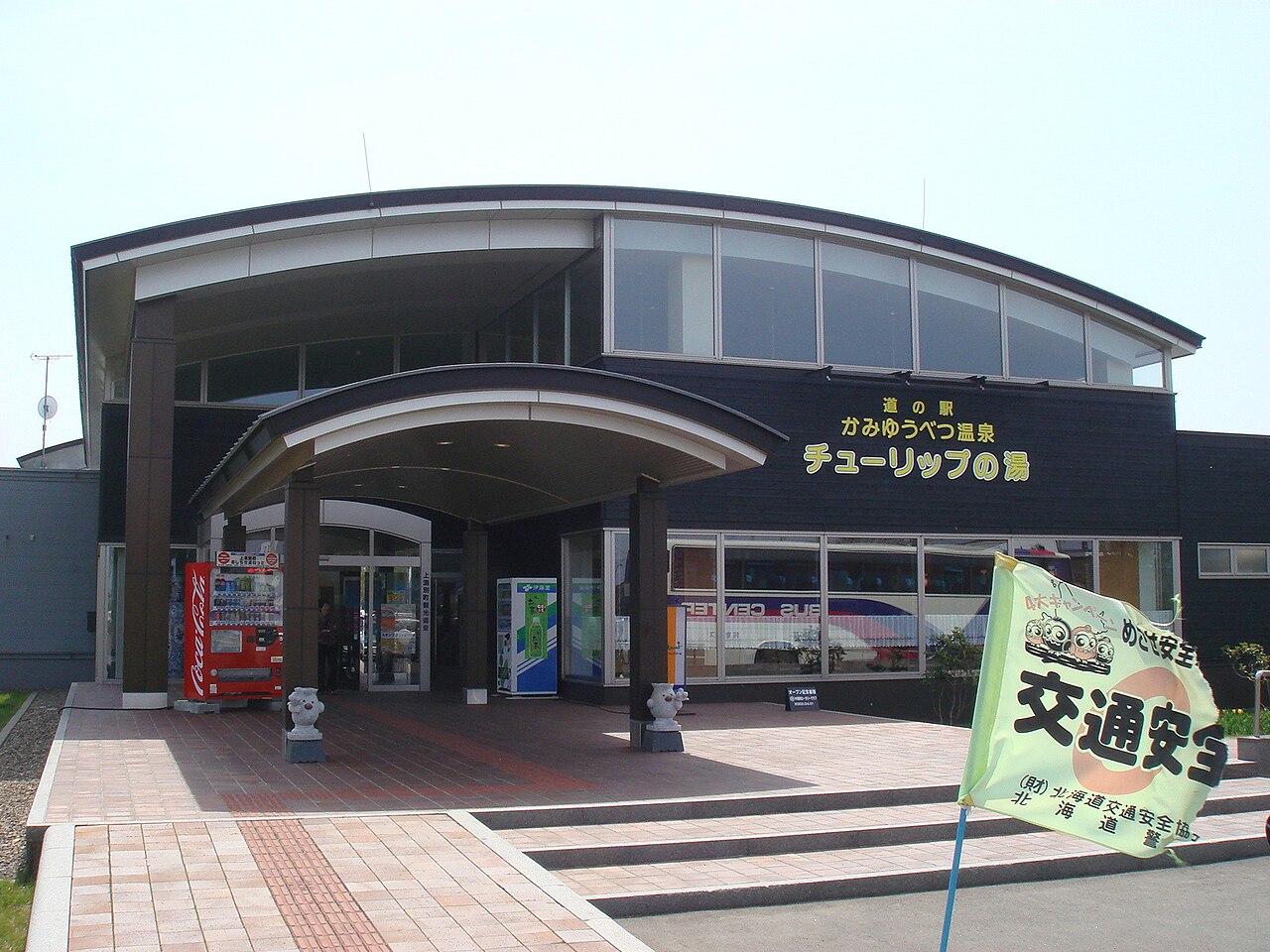
A detail worth knowing: the roadside station is the only major public-facing facility in Yubetsu town that’s open year-round. If you’re driving the northeast Hokkaido coast outside the park’s May festival window, it’s the logical stop for lunch, toilets, and a soak.
Getting there and logistics
Yubetsu is one of the more remote tourism spots in Hokkaido. The logistics:
By car (recommended): Pick up a rental at Asahikawa Airport or New Chitose Airport, drive 4-5 hours (via the Asahikawa-Monbetsu Expressway). Free parking at the park for 400 cars, rarely fills except on peak festival weekends.
By air + rental: Fly ANA/JAL to Okhotsk-Monbetsu Airport (roughly ¥35,000 return from Tokyo Haneda). Pick up a rental car at the airport — 30-minute drive to the park.
By train + local bus: JR Hakodate Line + Sekihoku Line from Sapporo to Engaru Station (3.5 hours), then Kitami Bus #1 from Engaru to Kamiyubetsu (20 min). Bus frequency is low — 4-5 departures per day — so check times carefully. Only worth doing if you don’t have a car.
Festival-season shuttle bus: During the May festival period, a direct shuttle runs from Asahikawa Station to the park on weekends and public holidays. ¥3,000 round trip, bookable through the Hokkaido Bus website; sells out 2-3 weeks ahead for peak weekends.
Combining with other eastern Hokkaido spring sights
If you’re planning the eastern-Hokkaido flower circuit, Kamiyubetsu pairs naturally with:
Takinoue Shibazakura Park — 30 minutes west by car. Same season (May bloom window), different flower (moss phlox vs tulips). The two parks coordinate their festivals so the peak windows overlap — a single weekend can hit both.
Saroma Lake — 45 minutes east. Japan’s third-largest lake, with oyster farms, birdwatching, and a small-scale onsen cluster on the northern shore.
Abashiri (70 minutes east) — the old prison-and-drift-ice town, with the Abashiri Prison Museum and the Okhotsk Ryu-hyo Museum. Worth an overnight anchor for the eastern Hokkaido loop.
Monbetsu (30 minutes north) — the nearest city, drift-ice museum, port tours, the regional hub for eastern-Okhotsk accommodation.
Where to stay
Yubetsu itself has thin accommodation — a handful of minshuku and one small business hotel. For broader inventory, use:
Monbetsu (30 min north) — 3-4 proper hotels (¥8,000-14,000 range), including the Okhotsk Palace Hotel with drift-ice-themed rooms. Main base for the eastern Okhotsk coast.
Engaru (50 min south) — smaller town, a couple of business hotels in the ¥6,500-9,000 range. Closer to the park.
Kitami (90 min southeast) — proper small city with full business-hotel inventory (¥7,500-12,000) and the Kitami Onion Pork signature dish. Longer commute but more dining and nightlife.
For a Tulip Fair + Takinoue Shibazakura combined trip, aim to stay in Monbetsu (equidistant from both parks) or Engaru (on the route between them). Booking.com’s Hokkaido listings cover all three clusters.
Is the park worth the trip?
For flower enthusiasts specifically — yes, Kamiyubetsu is one of Japan’s top three tulip displays (alongside the smaller Sakata park in Yamagata and the theme-park-style tulip gardens at Huis Ten Bosch in Nagasaki). 700,000 plants across 7 hectares is genuinely rare scale, and the Dutch-variety diversity is unmatched domestically.
For general Hokkaido travellers doing the eastern-coast circuit — yes, as a half-day stop. Combined with Takinoue the same morning or afternoon, and the Abashiri cluster on a following day, Kamiyubetsu fits into a reasonable 3-4 day eastern Hokkaido itinerary.
For first-time Japan visitors — skip unless you’re specifically in Hokkaido already. The travel distance (4-5 hours from Sapporo, plus another 4-5 hours to get from Tokyo to Sapporo in the first place) is too much for a single flower park unless it’s a dedicated trip theme.
For photographers and gardeners — pilgrimage-level destination, specifically during peak bloom weekdays. The design work and the Dutch-cultivar diversity reward slow exploration, and the shoulder weekdays have minimal crowds.
FAQ
When is peak bloom?
Mid to late May, typically May 15-25. Earliest recorded peak was May 11 (warm 2023 spring); latest was May 27 (cold 2019 spring). The park’s daily bloom percentage is posted on the Yubetsu tourism website from late April through the festival.
Is the park accessible year-round?
No — the park is open only during the May festival and closes for 11 months of the year. Outside the festival, the grounds are fenced off and the bulbs are dormant underground. If you show up in July or November, you’ll see a closed gate and an empty field.
Can I actually buy and take tulips home?
Yes, during the late-festival dig-your-own period (usually the final 10-14 days of the festival). ¥100-300 per flowering bulb, brought up with the plant and the attached soil ball. These will transplant successfully to overseas gardens if declared at customs and phytosanitary-certified; most travellers just enjoy them in-country during the trip. The park also sells packaged dormant bulbs for autumn planting (¥300-800 per pack) at the souvenir shop.
Is the park genuinely Dutch-themed?
Lightly so. The windmill observation deck is real architecture (a fully built 5-storey structure), not a prop. The canal and bridge sections are scaled-down and decorative. The overall feel is “Japanese interpretation of Dutch rural aesthetic” rather than “actual transplant of the Netherlands” — the aesthetic reference point is Huis Ten Bosch in Nagasaki rather than anywhere in real Holland.
How does the park compare to Huis Ten Bosch?
Completely different scale and purpose. Huis Ten Bosch is a full Dutch-themed amusement complex with hotels, restaurants, and year-round entertainment; it has about 300,000 tulips as one component. Kamiyubetsu is a single seasonal display with 700,000 tulips as the entire focus. If you want a Japanese Dutch-theme experience, go to Huis Ten Bosch; if you want a pure flower display, come to Kamiyubetsu.
Is there food in the park?
Yes, a reasonable festival-food cluster during the May period — jingisukan (Hokkaido mutton BBQ), fresh uni (sea urchin) rice bowls from visiting Okhotsk-coast vendors, standard Japanese festival fare like yakisoba and shaved ice. Prices ¥400-1,500 per item. The Tulip no Yu restaurant 5 minutes away has a proper sit-down menu if you want a fuller meal.
Is it a good stop for non-flower-enthusiasts?
Mixed. For anyone who genuinely doesn’t care about flowers, 45 minutes at the park is enough — climb the windmill, walk one path, eat a snack, leave. The combined Tulip no Yu onsen stop adds genuine non-flower interest. If you’re dragging a reluctant partner or teenager, plan for 2 hours total (park + onsen lunch) rather than half a day.


_-_panoramio.jpg)

